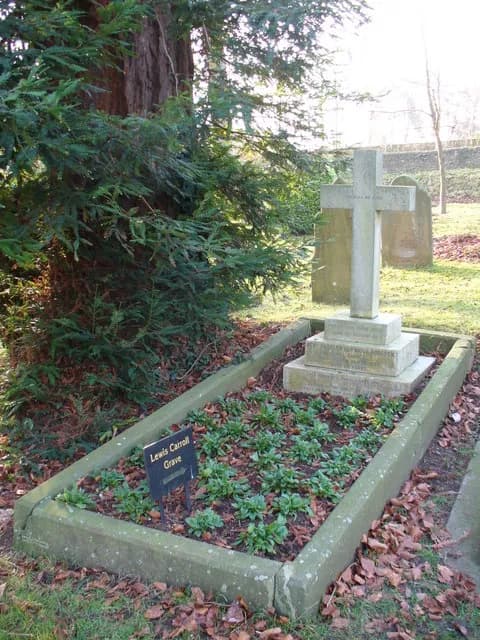
The creator of Alice's Adventures in Wonderland spent his final days in Guildford, where he died on 14 January 1898 at the age of 65.
The Mathematician Who Became a Literary Giant
Charles Lutwidge Dodgson, known to the world as Lewis Carroll, achieved fame as the author of one of English literature's most enduring children's fantasies. Born in Daresbury, Cheshire, on 27 January 1832, Dodgson spent most of his adult life as a mathematical lecturer at Christ Church, Oxford, a position he held from 1855 to 1881. He adopted the pen name Lewis Carroll in March 1856.
His literary output extended well beyond the Alice books. In the final decade of his life, he published Sylvie and Bruno in 1889 and its sequel Sylvie and Bruno Concluded in 1893. These later works, though less celebrated than his Wonderland tales, demonstrate that Carroll remained creatively active until shortly before his death.
A Family Connection to Guildford
Carroll's connection to Guildford stemmed from family ties. His sisters maintained a residence in the town, and it was here, surrounded by family, that he spent his final weeks. Carroll had suffered from chronic chest weakness since contracting whooping cough at the age of 17, and his health declined in the closing years of the 1890s.
The precise details of his Guildford residence remain unclear from available records, though the town's association with the author is well established.
Mount Cemetery: The Final Resting Place
Carroll was laid to rest at Mount Cemetery, sometimes referred to as Guildford Cemetery, situated on the western North Downs near the Hog's Back. The cemetery occupies a commanding position on the 'Guildown' or 'Mount' section of the downs, with coordinates placing it at 51°13′51″N 0°34′58″W.
The Dodgson family plot at Mount Cemetery holds more than the author's remains. Carroll's younger brother, Edwin Heron Dodgson, who served as a missionary, is buried alongside him. Five of the seven Dodgson sisters also rest in the same family grave, making the site a significant memorial to the entire family.
The cemetery, which also contains war graves of 33 Commonwealth service personnel from both World Wars, remains an active burial ground with a chapel on its grounds.
Guildford in 1898
When Carroll died, Guildford was a prosperous market town of approximately 14,000 residents, a significant decrease from its medieval peak but still an important centre in west Surrey. The town had benefited from the arrival of the railway in 1845, and the River Wey Navigation, opened in 1653, continued to support local commerce.
Carroll's death in January 1898 brought the town an unexpected literary association that persists to this day. His grave has since become a site of pilgrimage for readers and scholars from across the world.
Literary Tourism Today
Mount Cemetery remains accessible to visitors wishing to pay respects to one of English literature's most inventive minds. The Dodgson family graves are marked and documented, and photographs of the site have been contributed to public archives by local residents.
The Lewis Carroll Society continues to promote scholarly and public interest in the author's life and work, with his Guildford connection forming part of the broader narrative of his remarkable career.