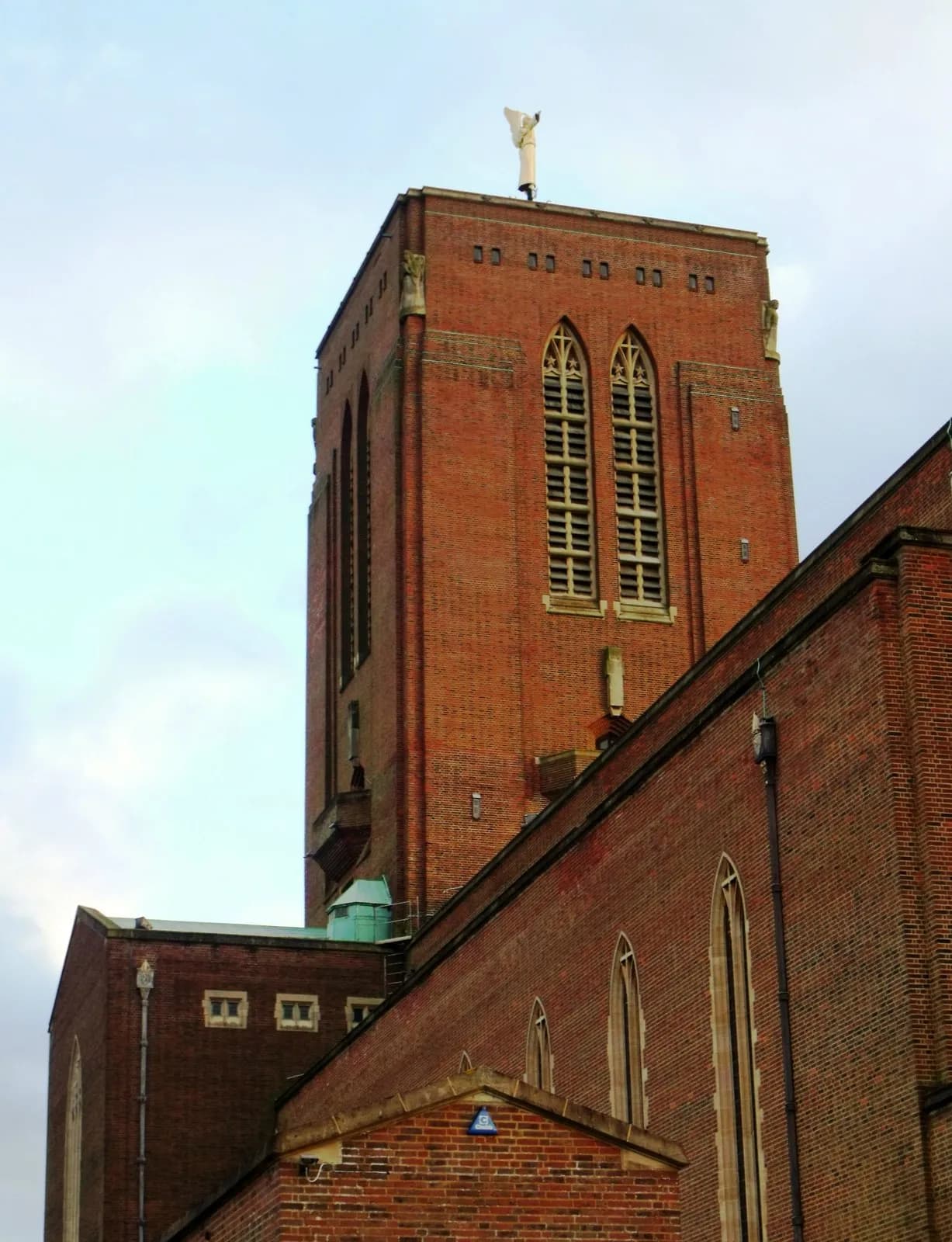
Guildford Cathedral stands as one of the last Church of England cathedrals built on a new site in the twentieth century. Its construction represents an extraordinary community effort, with more than 200,000 people contributing directly to its creation through the Buy-a-Brick campaign.
From Diocese to Dream: The Early Years
The Diocese of Guildford was established on 1 May 1927, carved from the Diocese of Winchester. Within five years, the cathedral committee launched an architectural competition that attracted 183 entries from across the country. Edward Maufe, later knighted for his work, won the commission in 1933 with a design that bridged Gothic tradition and twentieth-century technique.
Richard Onslow, 5th Earl of Onslow, donated the first six acres of Stag Hill for the project in 1933. Construction began in earnest with the erection of the Ganges Cross in April 1933, fashioned from teak timbers salvaged from HMS Ganges. Archbishop Cosmo Lang laid the foundation stone on 22 July 1936, and 778 piles were driven up to 50 feet into the clay beneath the hill. Queen Mary personally drove the final pile in April 1937.
War and Interruption
Work halted in 1939 with the outbreak of the Second World War. The half-built structure stood silent for nearly a decade. In 1947, Viscount R.B. Bennett, former Prime Minister of Canada, purchased the remaining land on Stag Hill as a memorial to Canadian soldiers billeted in the area during both world wars. This Commonwealth connection would later see the Lady Chapel funded by the Canadian people.
Construction recommenced in 1948, though post-war restrictions on building materials slowed progress considerably. Full-scale work only resumed in 1952, when the Buy-a-Brick campaign transformed the project from an ecclesiastical ambition into a popular movement.
The Buy-a-Brick Campaign: A Nation's Cathedral
Miss Eleanora Iredale, described by contemporaries as a "formidable" organiser, served as secretary to the cathedral committee and masterminded the fundraising effort. Provost Walter Boulton, appointed in 1952, worked alongside her to launch a scheme that would capture the imagination of the British public.
For two shillings and sixpence, half a crown, donors could purchase a brick and have their name, or the name of a loved one, inscribed upon it. The campaign ran from 1952 until the consecration in 1961. Subscribers came from across the diocese and throughout the United Kingdom. School children pooled their pocket money. Honeymooning couples bought bricks to commemorate their marriage. Families purchased bricks in memory of the departed.
Queen Elizabeth II and Prince Philip both signed bricks, which remain on display in St. Ursula's Porch. The bricks themselves were manufactured from clay excavated from Stag Hill during the foundation work, literally built from the earth upon which it stands.
Consecration and Completion
Bishop George Reindorp consecrated Guildford Cathedral on 17 May 1961, in the presence of Her Majesty The Queen and Prince Philip. At that ceremony, the building was still incomplete; the tower, Lady Chapel, and other elements remained unfinished. The final works, including the Western Porches, Sacristy, Chapter House, and the 160-foot tower topped with its 15-foot gilded angel, were completed by 1966.
The gilded angel serves as a memorial to Sergeant Reginald Adgey-Edgar of the Intelligence Corps, who died in 1944. Designed by William Pickford and positioned in Spring 1963, it now also houses mobile telephone antennae within its supporting pole.
Living History
Guildford Cathedral was granted Grade II* listed status in 1981. It remains the seat of the Bishop of Guildford, serving a diocese that stretches across Surrey, northeast Hampshire, and into Greater London, encompassing 160 parishes and 217 churches.
Today, many Guildford residents retain a personal connection to the cathedral. Generations of families return to trace the bricks bought by grandparents or great-grandparents. The cathedral continues as an active place of worship, hosts University of Surrey graduations, and has served as a filming location for productions including "The Omen" (1976), "The Sandman", and "The Witcher".
The Buy-a-Brick campaign created something rare in English ecclesiastical architecture: a cathedral genuinely owned by its people, brick by brick, name by name.