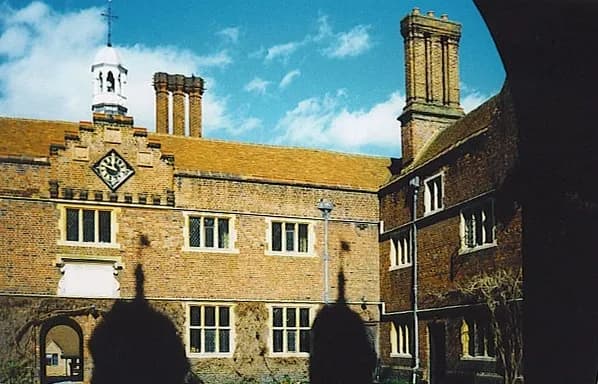
A Son of Guildford Returns Home
On 29 October 1621, twelve elderly men and eight elderly women stepped through the gates of a newly completed courtyard on Guildford High Street. They were the first residents of what their benefactor had named the Hospital of the Blessed Trinity, though Guildford would come to know it simply as Abbot's Hospital. The date was no accident: it was the 60th birthday of George Abbot, Archbishop of Canterbury, who had been born in a clothworker's cottage by the River Wey in this same town.
Abbot had risen from modest beginnings to the highest ecclesiastical office in the land. Born on 29 October 1562 to Maurice Abbot, a cloth worker, he was educated at the Royal Grammar School on Guildford High Street before attending Oxford. He was appointed Archbishop of Canterbury in March 1611, a position he held until his death in 1633. During his tenure, he served as one of the translators of the King James Version of the Bible. Yet he never forgot the town of his birth.
The Archbishop's Endowment
In 1619, Abbot purchased land in Guildford and endowed the hospital with estates valued at £300 per year. The charter, granted by James I, established an institution that would endure for more than four centuries. The original purpose was straightforward: to provide homes for elderly Guildford residents who had fallen on hard times. The conditions were strict: residents had to be single, and the original establishment could accommodate only 20 people—twelve men and eight women.
The architecture reflected the founder's Oxford connections. The Upper Courtyard, constructed between 1619 and 1621, was laid out in the style of contemporary Oxford and Cambridge colleges. The Grade I listed building remains one of the finest examples of Jacobean architecture in Surrey. Its position on the High Street, directly opposite Holy Trinity Church, was deliberate: Abbot is buried there, his tomb erected in 1635 by his brother, Sir Maurice Abbot.
Four Centuries of Continuous Care
Abbot's Hospital has operated continuously since that first intake in 1621. The institution survived the English Civil War, the Restoration, the Industrial Revolution, and the transformation of Guildford from a modest market town into a thriving Surrey hub. Throughout, its core mission remained unchanged: to shelter Guildford's elderly in need.
Governance has always kept the hospital rooted in local life. The governors include the Mayor of Guildford, the priests of the three nearest Anglican parishes, the Headmaster of the Royal Grammar School, and appointees from Guildford Borough Council. The Archbishop of Canterbury serves as official visitor. This structure, established centuries ago, ensures that the hospital remains accountable to the community it serves rather than to distant trustees.
Adapting to Changing Times
The hospital has adapted its rules as social expectations evolved. The original requirement that residents be single has been relaxed; couples, widowed persons, and single elderly residents are now eligible provided they meet three criteria: they must have a connection to the borough (by birth, residence, or family), their wealth must fall below a certain ceiling, and they must be sufficiently healthy to live independently.
Physical adaptations came later. In 1984, a set of flats was constructed in the lower courtyard, providing accommodation for seven couples. This extension allowed the hospital to house more residents without compromising the integrity of the original Jacobean structure. A major restoration followed in 2004, when an appeal raised more than £500,000 for renovation work. The result is a building that retains its historic character while meeting modern standards of comfort.
A Living Connection to Guildford's Past
Abbot's Hospital stands as one of the most visible reminders of Guildford's history. The town remembers its most famous son not only through the hospital but through a statue on the High Street and the George Abbot School in Burpham. The hospital's location—opposite Holy Trinity Church where Abbot lies buried, and within sight of the Royal Grammar School where he studied—creates a network of historical memory in the heart of the town.
For over 400 years, the hospital has fulfilled the purpose its founder intended. The cloth worker's son who became Archbishop of Canterbury created something that outlasted his own considerable achievements: a permanent sanctuary for Guildford's elderly, funded by land he purchased with his own resources, governed by the town's civic and religious leaders, and operating still on the same High Street where he was born.
The Hospital of the Blessed Trinity, Abbot's Hospital, remains a working almshouse. Its residents live in a Grade I listed Jacobean courtyard, surrounded by the evidence of one man's determination that his success should benefit the town that made him.